
Carbon capture, utilization and storage
Carbon capture and storage (CCS) is an essential piece of the puzzle when it comes to reaching net zero. In fact, according to the IEA, we will need to increase our global carbon capture capacity to 1.6Gt CO2 by 2030 and continue raising it to 7.6Gt CO2 by 2050, if we are going to reach our goals on time.
That is why Alfa Laval is pioneering innovative solutions for more thermally efficient carbon capture, combining tried and true technology with brand new solutions. In fact, our broad portfolio of solutions can already reduce energy consumption in a CCS plant by up to 40%.
Optimized CCS process, reduced costs, and energy consumption
Carbon capture processes are energy intensive, with energy accounting for up to 60% of the total operational costs in a CCS facility. But, with the right heat exchanger technology, process optimization support, and thermal integration both up and downstream, you can maximize energy recovery and reduce energy consumption at the same time.
By partnering with Alfa Laval, you will gain full access to the technology and experience needed to find the most efficient heat exchanger solutions.
The CCUS value chain
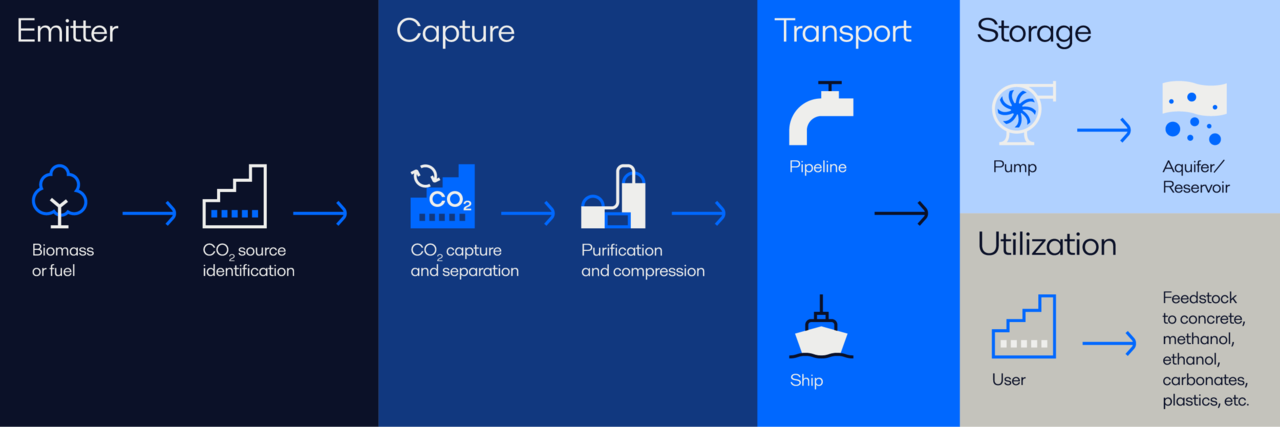
The CCUS value chain
Alfa Laval plays a crucial role in the CCS value chain thanks to decades of experience working with even the most crucial applications. Especially when it comes to the capturing process. In fact, we have installations in the oldest CCS facilities in the world that are still operating smoothly today.
So, whether you need to capture CO2 from industrial facilities, power plants, or directly from the air via Direct Air Capture (DAC), Alfa Laval has a broad range of products for your process.
Gasketed plate heat exchangers - Boosting energy efficiency in CSS applications
The unique design of Alfa Laval’s compact gasketed plate heat exchangers make it possible for you to significantly improve solvent cooling in your CCS processes. All with less fouling, stress, and erosion on the internal plates.
But that is not all. With Alfa Laval as your CCS partner, you can reduce cooling water requirements by as much as 30%!
Watch the video to find out how you can boost energy efficiency in you CCS applications.
Welded heat exchanger technology slashing energy costs by up to 40%
If you use an Alfa Laval Compabloc plate heat exchanger as your stripper reboiler, you can utilize the steam generated from flue gas cooling.
In other words, with Alfa Laval you can reduce fresh steam requirements, fuel consumption, and emissions from your steam boiler. Bringing your total energy costs down by as much as 40%.
CCS - Liquid absorption
With Alfa Laval heat transfer solutions positioned in the lean/rich interchangers, you can maximize energy recovery in the largest heat recovery duty in your process.
This includes minimizing energy and cooling water needs, while also maximizing CO2 capture efficiency and compressor savings.
Most critical positions:
- Excess heat recovery boiler
- Optimized solvent cooling
- Maximized heat recovery in lean/rich amine interchanger
- Plate heat exchanger for stripper reboiler
CCS - Direct Air Capture (DAC)
Thermal management is also critical when it comes to Direct Air Capture, as the concentration of CO2 in the atmosphere is much lower than the amount emitted in point source capture flue gasses. This means that the developing technology used to capture CO2 from the air consumes a high amount of energy per tonne of carbon captured.
Alfa Laval’s gasketed plate heat exchangers are a reliable solution to make sure that your DAC technologies are optimized with efficiency in mind.
Leveraging heat transfer in the carbon capture process
With the rapid development of carbon capture technologies, selecting the right system for your specific application is more important than ever. Key factors like space constraints, water availability, energy consumption, and CAPEX play a critical role in the successful deployment of your carbon capture technology.
Download our eBook to uncover the best-fit solutions for your post combustion or Direct Air Capture systems, designed to meet your unique challenges.
Download our technical report - Carbon capture with least OPEX and CAPEX
Save over 70,000 tonnes of CO2 from the cement production
Decarbonizing cement industries through CCU with advanced heat transfer technology: the carbon capture is estimated to save over 70,000 tonnes of CO2 from the cement production yearly. With the ambition to be carbon neutral by 2050, Heidelberg Materials has many upcoming decarbonization projects for their plants, taking the lead in the industry.

Accelerating cost-effective carbon capture
Alfa Laval heat exchanger technology has played a central part in over half of the world’s CCUS plants. Our unique Alfa Laval Packinox plate-and-frame heat exchangers are enabling the development of sites that will facilitate the possibilities of carbon capture at large economies of scale. Read this story to learn more about the role heat transfer plays in carbon capture and how we are working with major process licensors and end-users to make it possible.

Enabling e-methanol with CO2 utilization and advanced heat transfer technology
Once CO2 is captured, it can be utilized in downstream processes such as Power-to-X in e-methanol production. Combining green hydrogen with a CO2 source paves the way for e-methanol. Besides being used as fuel or for energy storage, e-methanol is also crucial for decarbonizing large parts of the chemical industry. Alfa Laval offers a unique portfolio of state-of-the-art heat transfer technology to, for instance, enable highly efficient e-methanol production.

Our solutions
Alfa Laval has a broad portfolio of heat exchangers to meet the energy-intensive demands of CCU/S applications. We can help you maximize energy recovery in a range of duties, including for lean/rich interchangers, the largest heat recovery duty in the process. We also offer solutions for minimizing energy and cooling water needs, while maximizing CO2 capture efficiency and reducing the cost for the compressor package and other process equipment.
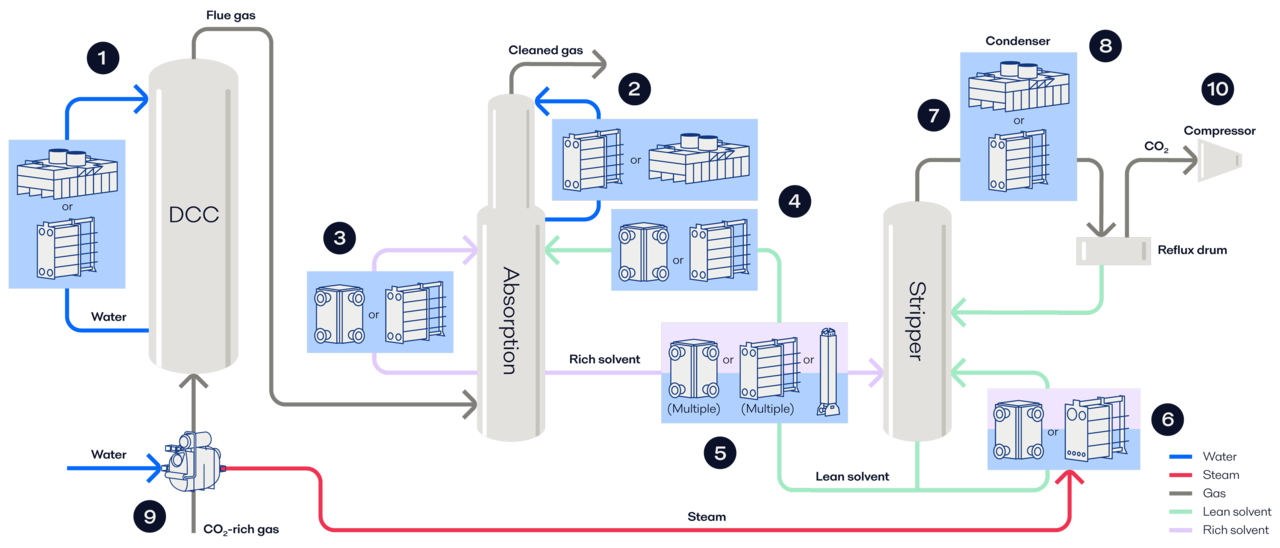
- Direct contact cooler (DCC)
- Wash water cooler
- Absorption tower pump-around cooler
- Lean solvent cooler
- Lean/rich solvent interchanger
- Stripper reboiler
- Stripper condenser
- Compressor interstage cooler
- Flue gas heat recovery, conditioning, and steam generation
- Super critical CO2 cooler